
Who is this post for: Engineers, designers and rack operators
Heatpumps with CO2 (R744) as refrigerant is getting more and more common. Depending on the desired supply temperature for the heatsink, the design needs to be engineering for robust operations. For district heating networks its not uncommon for supply temperatures ranging between 70°C and 85°C.
To make the heat exchanger, for delivering the energy to the heatsink efficient, a pressure of 110 bar in the gascooler during operations is desired.
This normally results in compressor racks that is designed for atleast 130 bar design pressure in the highpressure [HP] side of the compressors, oil separators and heatexchanger to deliver the energy to the heat sink.
The reason 130 bar design pressure is often choosed, is that most generic components is rated for maximum 130 bar.
When maximum pressure of the equipment is 130 bar, it means that the pressure switch in the common high pressure side is choosed to 117 bar (PS x 0,90) according to EN378.
Operating at 110 bar in the gascooler during operation, means that 117 bar is not far away, especially with compressors start/stop, or capacity steps on ejectors (if present).
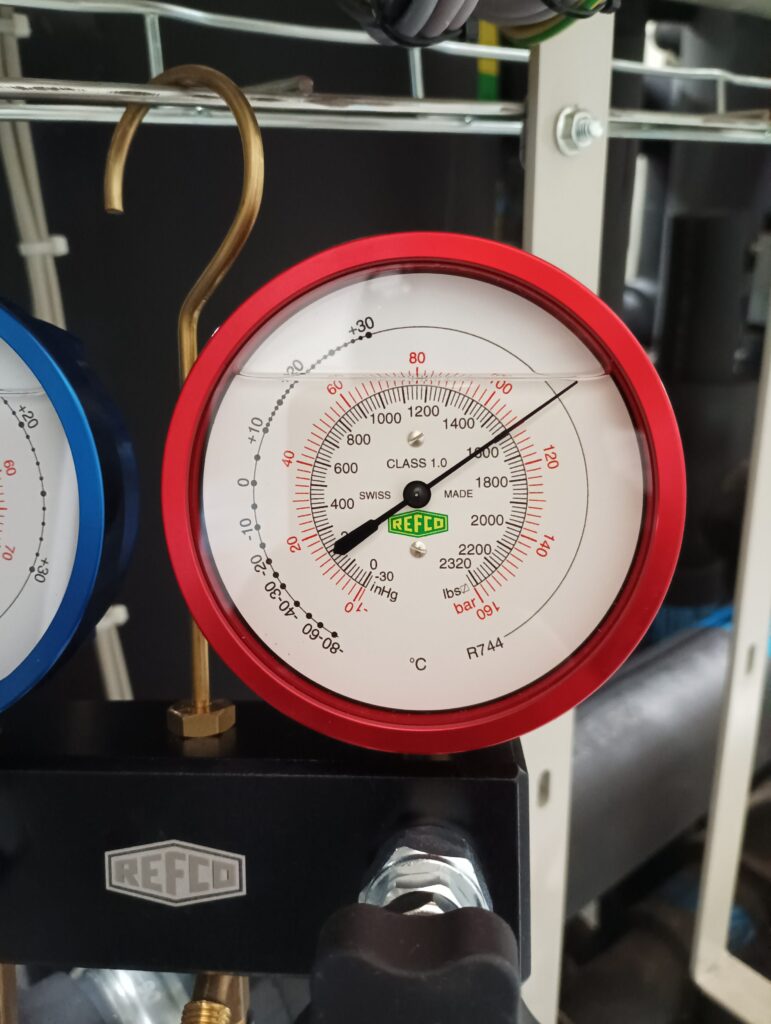
Connecting the manometer kit, is a much appreciated way to view how good the controls of the high pressure regulations works (Only connect a manometer set that is rated for the correct pressure).
If the needle on the manometer is smooth on 110 bar during start/stop of compressors and capacity steps on the highpressure regulation, all good.
But if you on the other hand experience unstable conditions, it gives you a hint that the compressor capacity settings, or the highpressure regulation settings needs a visit.
In worst case it can be necessary to change physical equipment as compressors or highpressure controls device.